Principles Behind These Metaphor Languages
Metaphor Mapping’s languages and workshop process were designed to help groups collaborate and perform at the highest possible level. Its four languages provide a robust tool set that enables participation of the full organization when group creativity and change are needed. They are tools for effective collaboration. Being time-efficient, they’re well suited for cascading workshops that ensure senior management’s vision is understood and applied to lower levels of the organization. Metaphor Mapping workshops are uniquely effective in creating a positive atmosphere that improves relationships and leads to openness, creativity and solutions.
The Workshop Process
A key design point is to help groups overcome three important challenges to effectiveness:
- Gain the numerous advantages of group diversity without a high cost in time to harmonize them
- Build allegiance to the whole, rather than a sub-unit
- Bridge gaps in perspective in order to achieve effective group thinking and and decisions
It creates a positive and stimulating environment where people with diverse interests and skills can better understand each other, build mutual trust and identify with a larger whole. Its methods include:
- Symbol languages, based on physical things known in all cultures, is the critical starting point to bridge the parochial languages and thinking styles of diverse disciplines. Sticker symbols, within metaphors, ensure that participants’ mental models become visible. They make it easy to frame issues effectively and avoid unproductive misunderstandings.
- Presenting the group with a common challenge, beyond their business issue– namely thinking visually and metaphorically. This causes each person to be more open and welcoming to the suggestions of others
- A map-building environment that requires building upon ideas of others, agreeing with the nuances of symbols that represent problems, goals and strategies.
- Requires walking around together and sharing many small, supportive behaviors such as writing descriptive signs, peeling off stickers, passing pens or scissors and agreeing scores of small symbolic decisions on symbol selection
- A requirement to show the big picture, with circumstances and interests of all stakeholders. The effect is to visually and emotionally understand the role of each as part of the whole. This requirement to step back encourages systems thinking, makes it easy to challenge “thought guards” and “group think”.
- Full understanding that most people reason by analogy. In a group context, this tendency is supported and amplified through the visual aid of metaphors and symbols. New ideas are less risky to put forward when the context is a bit playful as with the sticker symbols, further preparing the ground for original thinking by the group.
- Small sub-groups build agreed maps of the current state, vision and strategy. Their maps, however, are consolidated in a way that focuses only on the positive. The process asks the group to point out the views they all hold in common and unique ideas from the sub-groups they want to appear in the consolidated map. As a result, each person in the room sees their ideas are valued and included in the workshop results.
Target Audience further describes objectives for workshop design.
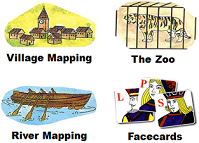
The following paragraphs briefly describe the design objectives of each of the languages.
Village Mapping
A village can be a metaphor for an interpersonal situation, a work process or any ongoing state of affairs. Creating a map of your village helps you to see the overall structure of the situation and focus on the essential.
The visual focus of the map you build is unavoidably the roads that represent relationships. They’re the glue and they tell the tale of whether things are working well or not. Assuming you have already read a bit about building Village maps on the site, you know that obstacles and opportunities can be shown with symbols like swamps or gold nuggets and they do draw your attention. But, its the ongoing relationships that are the heart of the map.
It’s the repetitive, habitual behavior that goes on between two people or groups. When you’ve built the village map or your situation, you’ve makes it physical, its there! The structure of the situation is open for discussion but it’s reality is undeniable.
Maps often tell a story of problems– one end of the road may act in total disregard for the other– as though the road type doesn’t matter– that something going on inside the building is far more important. You intuitively sense this state of affairs when you show a relationship as a curvy, straight, rocky road between two buildings. The people are wrapped up in what’s going on in their buildings and if the road is rocky it means that they are consumed with what’s going on in the building and not on the relationship. If the map-builders have shown a granite bridge between them, they have formed a relationship that will stand as long or longer than the building on either side– meaning the relationship can be of value even if the buildings are renovated or reconstructed.
If the map contains pyramids, it’s showing the big, timeless ideas that dominate the environment. See more about our Village Mapping workshop tool.
River Mapping
A river flows through your life or project or any sequence of actions needed to achieve an objective. The core focus is identifying, avoiding and or overcoming obstacles. Planning and getting things done is more than just bringing together a string of activities and accomplishing them one at a time. It includes anticipating obstacles and building-in resilience that comes from focusing on what can go wrong and how to react quickly and effectively when the anticipated problem or its relative occurs
The best plans include both rigorous logic and intuition about what might go wrong. They anticipate potentially negative outcomes as well as goals. See more about our River Mapping workshop tool.
The Zoo
You’re surrounded by a menagerie of creatures driven attitudes you can’t get. How to get beneath the surface and directly address attitudes and mindsets? Our answer is caricatures. Animal symbols. Avoid words & – they’re sure to be misinterpreted.
Interpersonal and inter-organizational problems very often have their roots in perception of their role and at other times their focus and priorities. If you “change languages” to The Zoo, you will gain new perspective and find it easier to see how others perceive you or your group. Animal caricatures will help you identify or express positive or negative emotions and discuss with others. Learn more about the Zoo.
Facecards
Who is really in charge? This is a question best asked early, not after things have gone wrong. If you can be perfectly clear who shoulders the burden of an activity, who has the right to be heard and the responsibility to help, and who has to take direction to achieve a result, your chances of success go way up.
The most clear way we could think of to show such a hierarchy that could be universally understood, was to borrow the relationships in the Jack, Queen and King in a deck of playing cards. It takes all the complexity out of assigning responsibilities. Explore Facecards.