Managing Culture Change in a Manufacturing Company
Background
Those organizations most often interested in changing their culture are usually those performing poorly, facing a crisis, newly reorganized under a larger entity and those with new missions or new managers. The example organization here is an exception to the general rule. (The company and setting have been disguised in this example)
Why change it if it ain’t broken?
Gordon Smith was VP of Manufacturing. His worldwide organization included plants, engineering and client support groups in China, Singapore, UK, Norway and USA. Gordon had been in his job for six years and could report that each year he had met his product delivery, inventory and quality objectives. But, it was his performance in cost reduction that had made corporate life pleasant for him– giving him freedom from oversight and the latitude to reward his staff with incentive trips, similar to the way the sales force was treated..
Gordon had inherited a motivated group of professionals, given them lots of headroom and had reduced overall costs by 8-10% in each of his six years. He ascribed much of his success to his personal, maniacal focus on cost, and having drilled the rallying cry of 15%! into each of his managers. That meant bring total manufacturing cost down to 15% of corporate gross revenue.
So,why change? It was clear to Gordon that the organization would keep up the momentum and achieve that 15% goal that had seemed so impossible, back when it was at 29% six years earlier. The low hanging fruit had all been harvested, global commodity price reductions had ended their downward drift and 15% was well under the industry average and the curve was most certainly going to slow. In short, there was little room left to be a hero by cutting cost. At the same time, his cot focus was starting to show its downside. Client complains were climbing, industry quality trends were outshining his and he sensed the whole organization was becoming too complacent and losing their enthusiasm.
So, change wasn’t forced on Gordon– he just thought it was time that the ship changed course. He knew the great rallying cry of 15% had to change and he didn’t have any sense of just which goals and rallying cry should replace it. As he contemplated his situation, he need for a more customer-focused manufacturing and discussed it with his HR leader, he came to recognize he had an asset he had never considered and probably couldn’t have named without HR help: a vibrant community. The organization, spread over four continents, had developed a strong sense of commitment to the good of the whole. He decided to call on his community to help him sort out new priorities and guide changes that would be needed in the culture. As for a new rallying cry, why not ask them for that too?
Starting the culture change process
Gordon asked his HR leader, Laura, to plan to call together the 50 key managers and leaders from all sites and propose a workshop structure that would set the organization on a changed course. Gordon fully intended to make final decisions but he wanted his community to collectively think out the options, make cases and advocate them.
After checking with colleagues who knew organization development consultants, Laura recommended Metaphor Mapping as the primary vehicle for the workshop. She liked what she heard about is ability to generate serious results but with a lighter touch than some other methods. Since thirty of the fifty participants would be traveling, she wanted it to be a fun and rewarding experience that would lead to good future teamwork as well as address Gordon’s main concerns. She wanted culture to be addressed in the context of the group’s work to fulfill its core mission. Optimizing processes and managing cost would always be a fundamental part of their mission, even if they took on an additional, customer-related, revenue promoting role.
The workshop was scheduled for April in a large room of a local hotel. Workshop agenda was planned and small group tasks defined in the areas of business process improvement, and culture change.
To keep this story from growing too long but still show some of the hands-on aspects, interested readers can review the attached PowerPoint slides that guided the conduct of the workshop and those that show a general summary of results. Community Driven Culture Workshop
In short, three process optimization tasks were assigned to six groups of 5 or 6 and one culture change task as assigned to two groups of 6. Breakout sessions were followed by plenary presentation sessions and then the next tasks assigned.
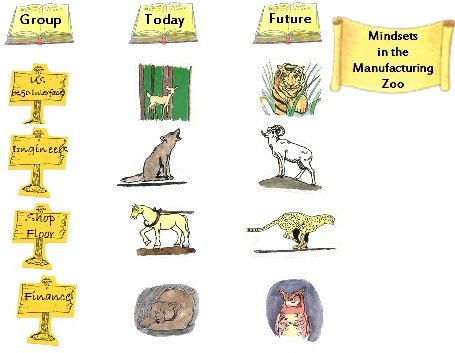
The interspersing of process improvement with culture analysis proved to be highly energizing. It became clear to all that the values, attitudes, mindsets and behaviors of team members would be a critically relevant factor in their future success. The following image is the output of the small group work session related to the R&D Interface group. It shows that team’s belief that:
The R&D Interface group considered themselves today to be a bit naive and a little lost. They took direction from R&D, did what they were told and were at a loss of how they could add any further value. They symbols they chose for themselves, with more than a little regret, was a fawn lost in the woods. In future, with support of their VP and others, their view was they should take on a highly aggressive role characterized by their championing elimination of product features known to cause difficulties for both customers and for the manufacturing process. Customers (as well as the company) wanted fast delivery and products that could be immediately put into production, without the kind of customizing that was often built-in by Research— They would take up this cause and “be tigers about it!”
They looked at the behaviors they saw in Engineering today and were quick to label them a coyotes, howling at the moon. They considered the manufacturing engineers as being content to complain to themselves about the designs they received from Development but not willing to put in the extra effort to back up their concerns with their own analysis and take on the political risk of making alternate proposals. In future, they wanted the engineers to act like big horn sheep. They wanted an agile, sure-footed group that would gain a high vantage point that strongly defended the interests of both manufacturing and customers.
They saw the shop floor team as workhorses today. A team that did its job well but didn’t take on high degrees of risk when unique circumstances arose. In future, they wanted them to be much more fleet of foot, like a cheetah, capable of bursts of exceptional speed when needed.
Finance was characterized as a hibernating bear. While clearly a capable group and doing a great job on the 15% challenge, they showed no interest in looking beyond the borders of manufacturing to see the greater cost picture that included the impact of design flaws on manufacturing re-work or customer returns. They wanted them to apply their skill like wise owls who would analyze total company end-to-end product cost and make recommendations accordingly.
Summary of results
The workshop was a total success. The full fifty member management team became clear on the need to change overall objective from cost-containment only to a combination of continue cost diligence but add a new focus on actions that would improve customer satisfaction and help generate revenue.
Constructive recommendations for business process improvement were made and project teams assigned to run with improvements.
Culture was addressed for the first time in the organization’s history and its importance as a force for meeting goals was recognized. Many frank discussions of group behavior took place in the workshop and after-hours gatherings. The visual symbols were a big hit and the nuances of the symbols both initiated interesting and pointed side discussions but were also highly appreciated by the non-English speaking attendees for the clarity they brought to communications.